
Crimping Failure Analysis
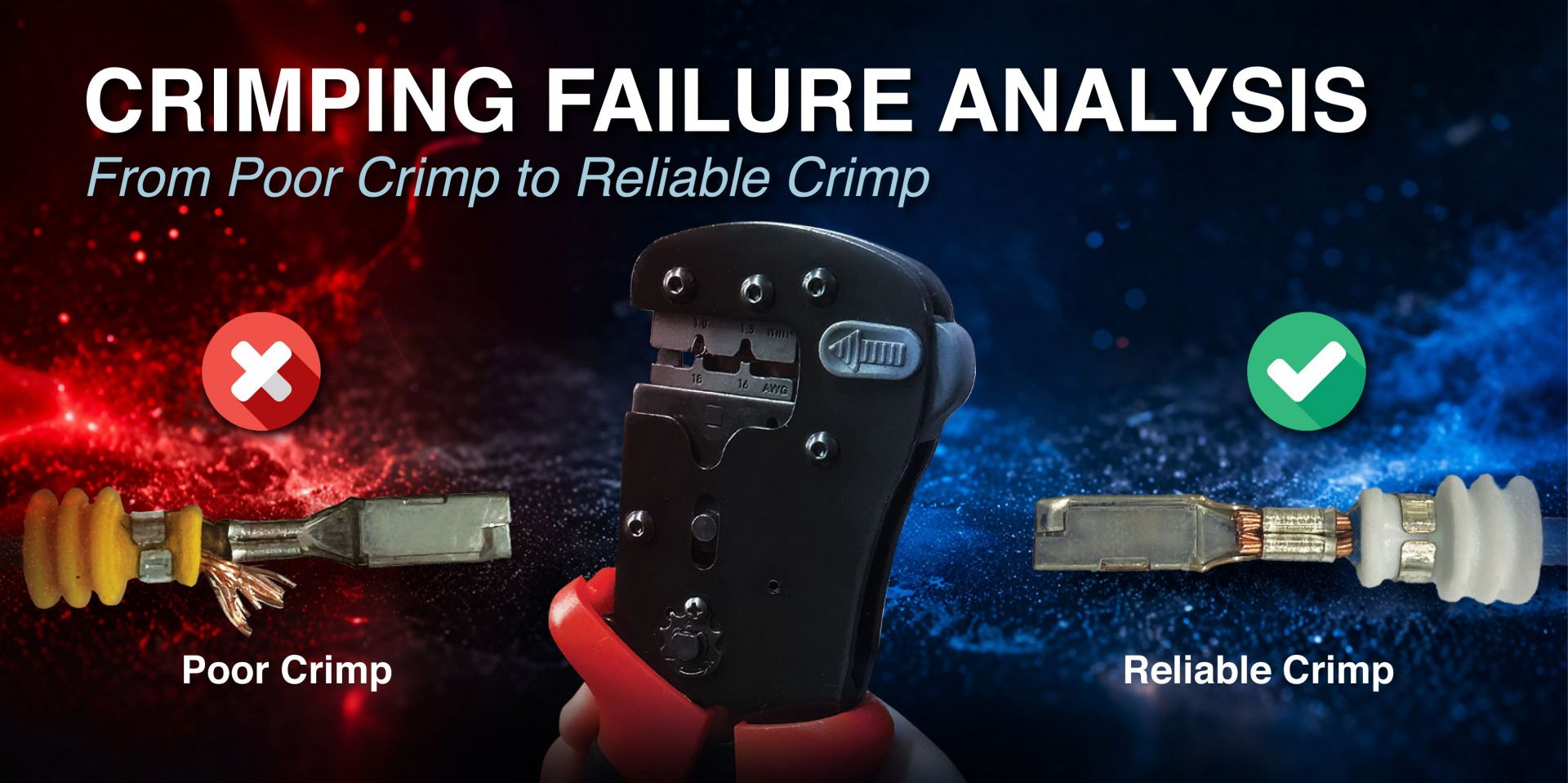
Understanding What Went Wrong — And How to Fix It
Poor crimping quality is one of the leading causes of electrical failure.
It can result in unstable connections, increased resistance, overheating, and ultimately system breakdown.
In critical applications such as automotive, EV systems, and industrial equipment, even minor crimping defects can lead to serious safety risks and reduced product reliability.
Common Crimping Failures and Root Causes
Crimping failures are typically caused by a combination of incorrect tool selection, improper technique, inconsistent force, and lack of process control.
These issues often result in the following common failure types:
1. Under-Crimping
Insufficient compression, often due to inadequate force or incorrect tool settings, leads to loose connections and high electrical resistance.
2. Over-Crimping
Excessive force damages conductor strands, reducing mechanical strength and long-term durability.
3. Incorrect Crimp Position
Misalignment between the terminal and conductor results in unstable or incomplete contact.
4. Insulation Damage
Improper die selection or excessive force weakens insulation support and increases failure risk.
5. Incorrect Tool or Die Selection
Mismatch between terminal and crimping die leads to inconsistent crimp geometry and unreliable performance.
Controlling these variables is essential to achieving consistent, safe, and reliable crimping results.
How to Prevent Crimping Failures
To ensure stable and reliable connections:
- Use the correct tool and die for each terminal
- Ensure proper positioning and alignment
- Apply consistent and calibrated crimping force
- Perform regular inspection and pull testing
- Follow standardized operating procedures
From Failure to Reliable Connection
Reliable crimping is the result of controlled processes, correct tooling, and consistent execution.
At Hsun Wang, we provide system-based crimping solutions designed to:
- Ensure consistent crimp geometry
- Improve efficiency across applications
- Reduce human error
- Support a wide range of terminal types